What to Expect from a Trichology Consultation — and Why It's One of the Best Investments You Can Make for Your Hair and Your Health
Contents
If you've been searching for answers about your hair loss and wondering whether seeing a trichologist is really worth it, today I want to answer that question properly.
Not with a sales pitch, but with complete honesty about what actually happens when you sit down with me, what you leave with, and why so many of my patients tell me they wish they'd come sooner.
I'm Ruth Collis, Consultant Trichologist & Specialist in PRP for Hair Loss, based in Haywards Heath, West Sussex. So let's work through it together.
Can you see a trichologist on the NHS?
The short answer is no, and I think it's important to understand why, because it speaks to something much bigger than access to appointments.
Hair loss is still widely classified as a cosmetic concern within the NHS. That means it is not considered urgent, not prioritised for referral, and not investigated with the depth it deserves. The frustrating reality is that hair loss is frequently a biomarker of health, a visible signal that something is happening internally that warrants proper investigation. Iron deficiency, thyroid dysfunction, hormonal imbalance, autoimmune conditions, these are not cosmetic issues. But because the symptom presenting is hair loss rather than something the medical system recognises as urgent, women in particular are routinely sent away without answers.
This is not a criticism of GPs, who are working within a system under enormous pressure. It is simply the reality, and it is one of the most important reasons why seeing a specialist trichologist privately makes such a meaningful difference.
What does a trichology assessment involve?
Today I want to walk you through exactly what happens when you come to see me, because I think when you understand what's involved, the decision to book becomes a much easier one.
Before you arrive, you'll complete a detailed consultation form. This covers your medical history, hormonal background, family history, medications, diet, sleep, stress, and much more. Every section exists because every section can matter. Hair loss is a whole-body problem, and I look at the whole body.
When you come in, we go through everything together, with a fine-tooth comb and without rushing. A first appointment with me runs between 45 minutes and an hour. For complex cases it goes longer. That time is not a luxury. It is what finding the right answer actually requires.
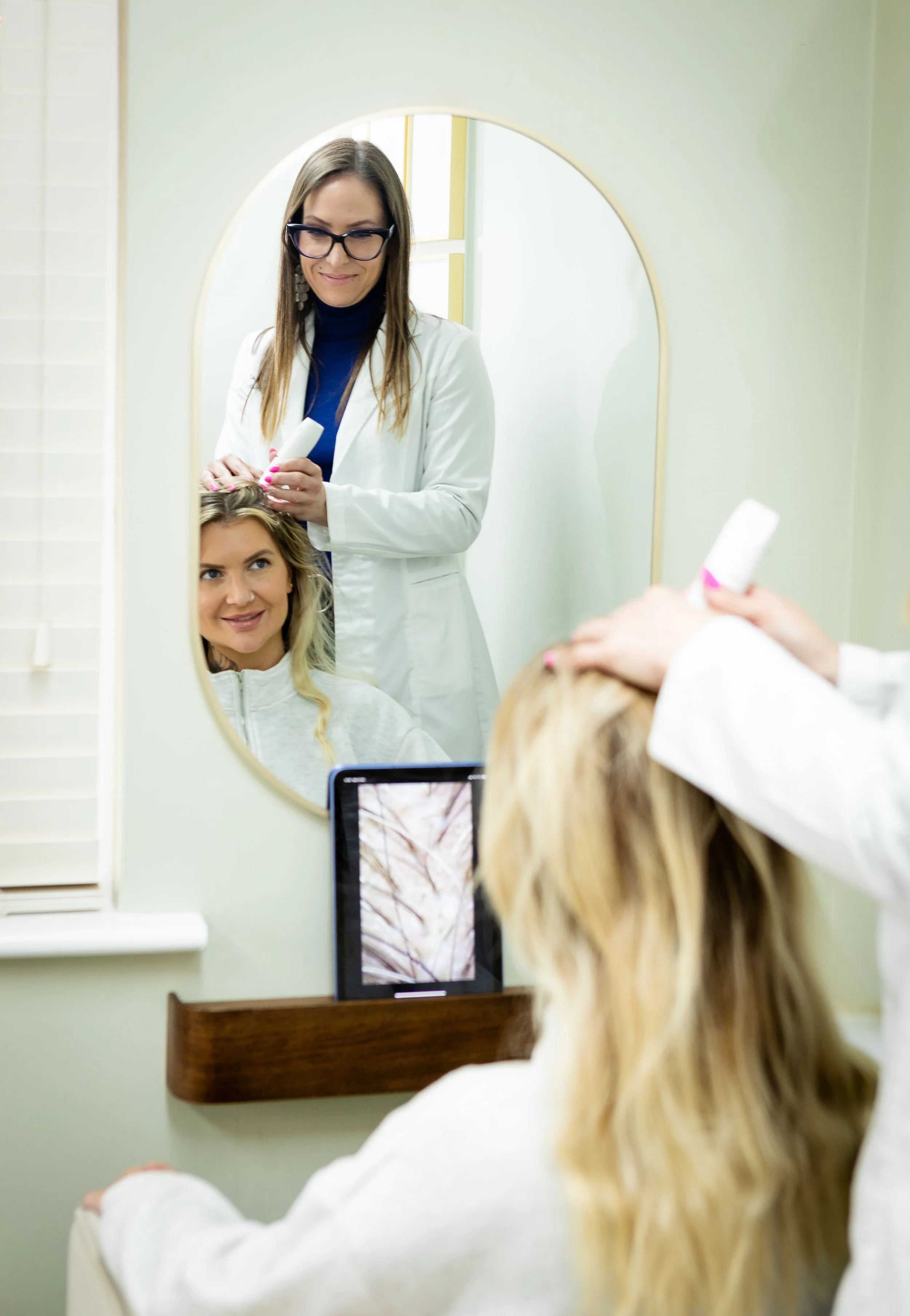
I then carry out a clinical examination of your scalp using a trichoscope, specialist magnification equipment that allows me to see what's happening at the follicle level in a way that's invisible to the naked eye. I'm looking at hair shaft diameter, miniaturisation patterns, scalp condition, and the ratio of different hair types to build a precise clinical picture. I also carry out a pull test, a simple but meaningful assessment of your current shedding activity.
What you leave with is just as important as what happens during the appointment. Every patient receives a detailed written summary, your diagnosis explained in plain English, the clinical reasoning behind it, and a personalised plan covering treatment, diet, lifestyle, and next steps. For some patients this runs to several pages. Where blood tests are clinically indicated, I write directly to your GP requesting the specific investigations relevant to your case. That letter is included as part of your consultation, at no extra charge.
Nothing about what I do is generic. It is built entirely around you.


How much does a trichologist consultation cost, and is it worth it?

I'm going to answer both of these questions together, because they're really the same question.
I don't publish my prices here because they are reviewed periodically. You can find current pricing at ruthcollistrichology.book.app. What I will say is this: the vast majority of my patients have already spent considerably more than the cost of a consultation by the time they come to see me. On serums, supplements, and treatments that promised results but weren't based on a proper diagnosis. On products with clever marketing and little clinical evidence. On months or years of trying things that couldn't possibly work because nobody had established what was actually wrong.
A consultation with me gives you a diagnosis. A personalised written plan. A GP letter where needed. And, perhaps most importantly, clarity. You leave knowing what is happening, why it is happening, and what to do about it. That is not something a serum can give you.
Is it worth seeing a trichologist? If your hair has changed and you don't know why, yes. Unequivocally. The question is not whether it's worth it. The question is how much longer you want to wait before getting a proper answer.
───────────────────────────────
Why qualifications matter, and what to look for
Not all trichologists are the same, and this is something I feel strongly about saying clearly, because the title is not legally protected. In theory, anyone can call themselves a trichologist. What protects you as a patient is knowing what to look for.
The Institute of Trichologists is the leading professional body for trichology in the UK, and the only organisation whose register is accredited by the Professional Standards Authority for Health and Social Care, an independent statutory body accountable to Parliament. When you're choosing a trichologist, checking that they appear on the Institute's register is the single most important step you can take. A short qualification from an unaccredited course is not the same thing. The depth of training, the breadth of clinical knowledge, and the professional accountability that comes with IOT membership cannot be replicated by a weekend course.
I am a member of the Institute of Trichologists, and I practise full time, which means my clinical hours far exceed those of many trichologists who see patients one day a week alongside other work. That experience matters. Particularly in complex cases, which are the ones I see most often.
Ready to book?
If you've been going around in circles looking for answers, a trichology consultation is where the guesswork stops. I see patients from my clinic at 143a South Road, Haywards Heath RH16 4LY, and regularly see patients from across West Sussex and Mid Sussex, including Brighton, Crawley, East Grinstead, and Burgess Hill.
No GP referral needed. No waiting list. Just a proper, thorough, personalised assessment from someone who genuinely understands what your hair is trying to tell you.
Your hair is worth investigating properly. So are you.
Frequently Asked Questions
Can you see a trichologist on the NHS?
No, trichology is not currently available as an NHS service. Hair loss is still largely classified as cosmetic within the NHS, which means it is not prioritised for referral or investigation even when it is signalling something clinically significant. All trichology consultations are private and self-funded.
What does a trichology assessment involve?
A full clinical consultation covering your medical history, hormonal background, family history, lifestyle, diet, and stress, followed by a scalp examination using specialist trichoscopy equipment, a pull test, and where needed, a GP letter requesting blood tests. You leave with a detailed written summary and a personalised plan.
How much does a trichologist consultation cost?
Current pricing is available at ruthcollistrichology.co.uk/appointment. What I'd encourage you to consider is not just the cost of the consultation, but the cost of continuing without a diagnosis, in time, in money spent on products that can't help, and in hair that could have been addressed sooner.
Is it worth seeing a trichologist?
If your hair has changed and you don't have a clear, clinically established reason why, yes. A trichologist gives you something no product can: an actual diagnosis, a personalised plan, and a clear path forward. Most patients tell me they wish they'd come sooner.
How do I know if a trichologist is properly qualified?
Look for membership of the Institute of Trichologists, whose register is accredited by the Professional Standards Authority for Health and Social Care. This is the quality mark that confirms your trichologist has met rigorous standards of training, clinical practice, and professional conduct.
Do I need a GP referral to see a trichologist?
No. You can book directly, without a referral, and be seen far sooner than a dermatology referral through the NHS would allow.
A note on this blog
I write these posts because I think everyone deserves clear, honest answers about their hair, before they spend more money, more time, and more energy going around in circles. If you have questions before booking, you're welcome to reach out at hairandscalpsolutions@gmail.com.
Ruth Collis AIT, Consultant Trichologist & Specialist in PRP for Hair Loss
143a South Road, Haywards Heath, West Sussex RH16 4LY
